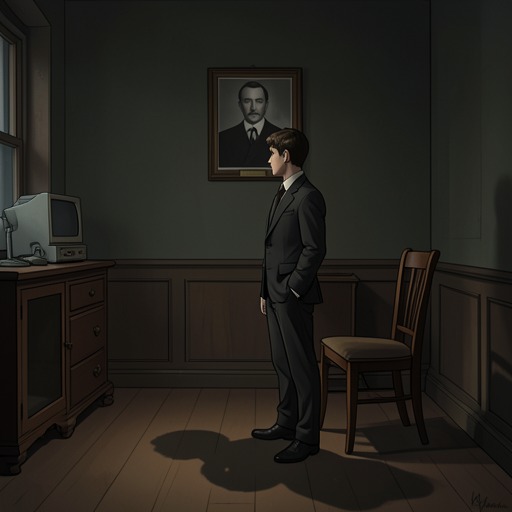
Finch Aborts His Carbon Monoxide Suicide Attempt
All the Bright PlacesTheodore Finch’s aborted carbon monoxide suicide attempt begins in the aftermath of a brief, unusually affectionate exchange with Linda Finch and ends with him driving out of the garage. Its significance lies in the reversal between those two actions: Finch sets a lethal course in motion, yet thoughts of his mother and sisters interrupt it. The scene also reveals that his hatred of Ted Finch is rooted in violence that has shaped the family since Finch’s childhood.
Immediate Background
Before leaving, Finch hugs Linda Finch and kisses her cheek, gestures that alarm her because the family is not accustomed to showing affection. He tells her he is going out; she urges him to be safe. Finch then says that he loves her too, which unsettles her further. The exchange is brief, but it gives the departure an intimate frame: rather than leave after an argument or an explicit farewell, Finch turns toward his mother with affection she is not expecting.
Once in the garage, Finch climbs into Little Bastard and feels better when the engine starts. That relief is quickly complicated by his shaking hands. He connects his anger toward Ted Finch to earlier violence against both Linda Finch and himself: when Finch was ten, his father sent his mother to the hospital, and a year later Finch was also a target. The present crisis therefore carries a family history into its confined setting. Finch is not only confronting his own wish to die; he is also sitting with anger toward the person whose violence has marked his home.
The Attempt
With the garage door still closed, Finch sits at the wheel and considers how easy it would be to remain there. He closes his eyes, leans back, and rests his hands in his lap. The sequence slows into small, passive gestures. Finch reports feeling little beyond sleepiness, and describes the darkness surrounding him as a persistent vortex. The subdued pace makes the attempt feel less like a sudden outburst than a withdrawal into stillness.
Finch’s thoughts take on the tone of an experiment. He recalls that deaths by car exhaust in the United States had declined since emission controls were introduced in the mid-1960s, while the rate in England, where such controls barely existed, had doubled. He also recalls a 2013 case in Pennsylvania in which a man’s family members died after trying to rescue him. These details show Finch approaching the attempt through facts and calculation, but they also place other people inside a plan he might otherwise imagine as solitary. The remembered case makes clear to him that the consequences could extend beyond himself.
He pictures himself floating on his back in water, motionless except for a beating heart, and imagines that those who find him will think he is asleep. The image turns death into an imagined appearance of rest. Its calmness stands in tension with the danger of the situation and with the anger he has just associated with his father. Finch’s effort to empty his mind does not erase the people around him: the possibility of his family finding him remains part of the scene, even before he consciously thinks of them again.
Reversal and Aftermath
Finch thinks of Linda Finch, Decca Finch, and Kate Finch. He then opens the garage door and drives away. The action is immediate, but the narrative does not present it as a settled recovery or a resolution of the conditions that brought him there. It is the decisive change within this episode: after sitting still and imagining that he will be found asleep, Finch chooses movement and leaves the enclosed space.
For roughly the first mile, he feels exhilarated, comparing the sensation to running into a burning building and saving lives. The comparison recasts his departure as a rescue, but Finch almost at once rejects that heroic interpretation. An inner voice calls him a coward and frames his action as having saved his family from himself. The contrast makes survival emotionally unstable: leaving the garage is both a concrete interruption of the attempt and, in Finch’s own judgment, a failure of courage rather than an uncomplicated victory.
Significance
The scene brings together Finch’s difficulty expressing tenderness, his history of family violence, and his capacity to imagine the consequences of his death. His unexpected affection toward Linda Finch precedes the attempt, while thoughts of her and his sisters precede his departure. Those gestures and recollections do not make the danger disappear; they mark the relationships that break into his otherwise narrowed attention and alter what he does next.
The episode’s formal movement—from a quiet farewell, to stillness in the car, to driving out, and finally to self-condemnation—keeps the outcome deliberately divided. Finch has survived this particular attempt, but the brief exhilaration gives way to an accusation rather than relief. The act of leaving is consequential without becoming a cure: it interrupts the immediate crisis while revealing how little Finch’s own account of survival allows him to call it a triumph.